After the Ice
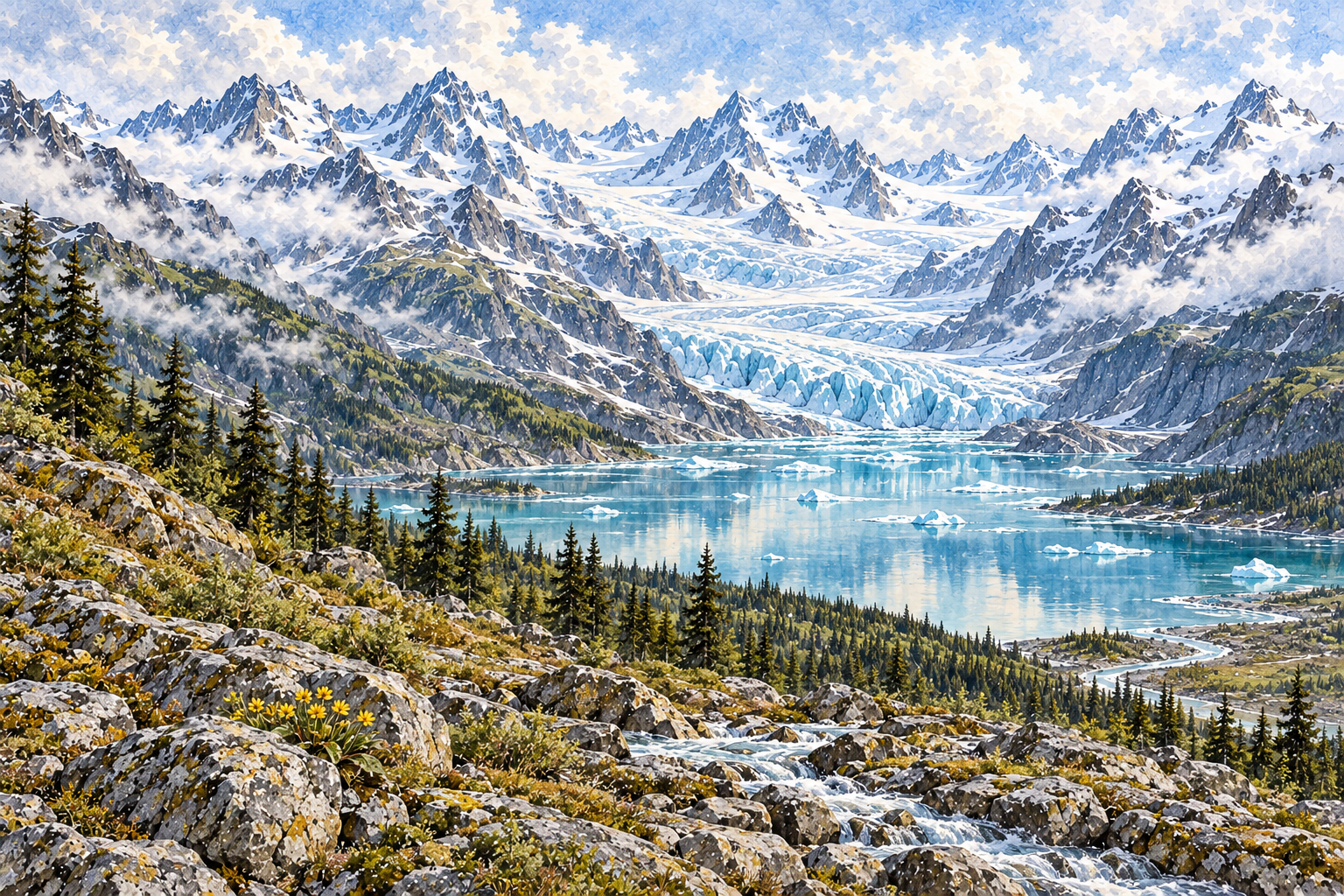
One valley, two worlds
For as long as anyone could remember, the world had been white.
Ice covered much of the northern continents, filling valleys, burying plains, and pushing out from the mountains in blue-white rivers whose movement was too slow to see. Cities had grown along the edges of the great ice sheets. Their engineers drew drinking water from glacial streams and set foundations in ground they believed would remain frozen for another thousand years. Freight trains crossed the plains on embankments of permafrost. In winter, trucks used the frozen lakes as shortcuts, their headlights moving in lines across the darkness.
It was simply the condition of the world.
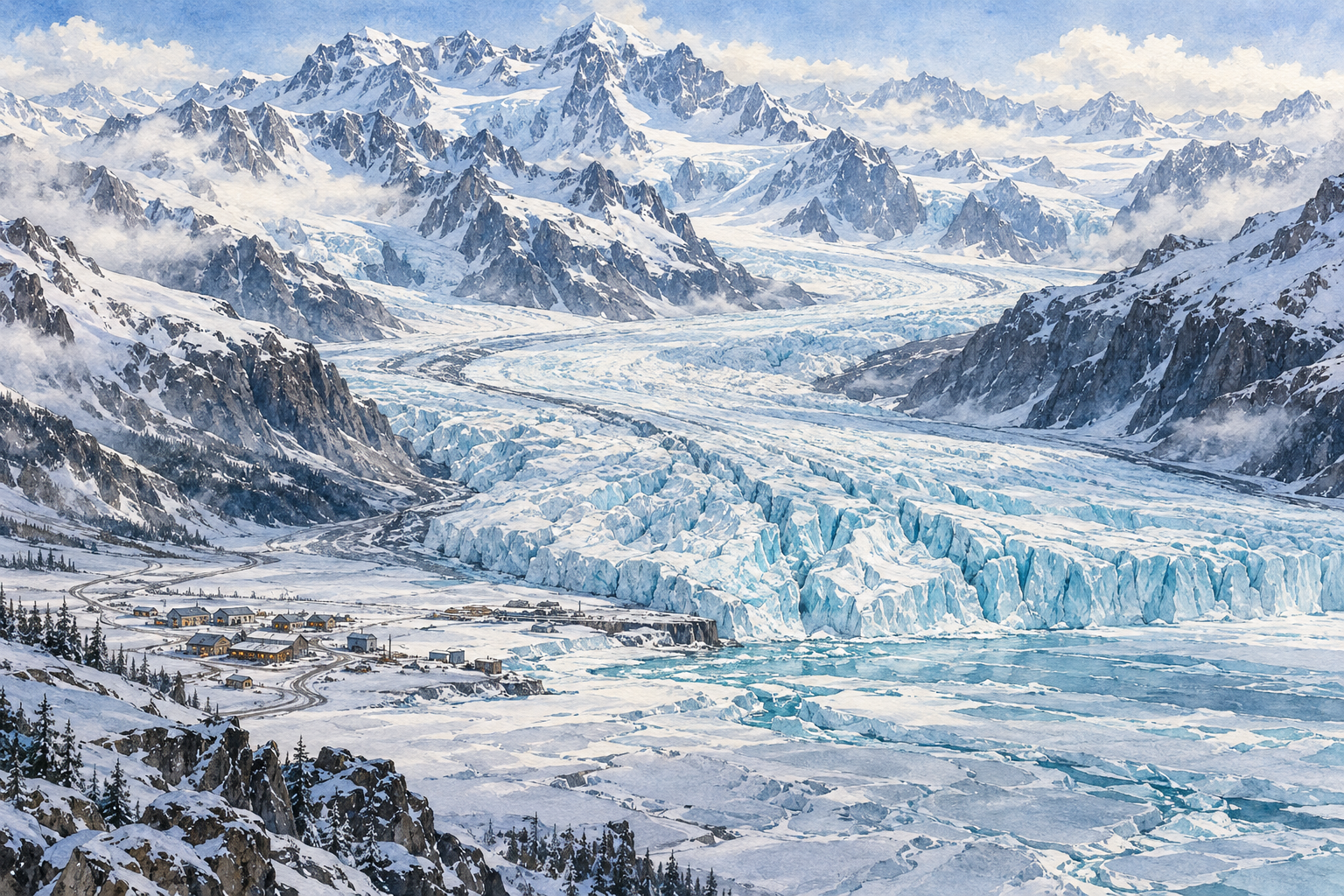
No one called it an Ice Age. The term belonged to historians, to ancient strata and periods no one living could remember. Families took their holidays in ice caves, where blue light shone through the walls and water dripped onto wooden walkways. National parks protected the largest glaciers. At the best hotels, rooms facing the ice cost more than those facing the streets.
In school, children learned the boundaries of the northern ice sheets before they learned the names of the rivers beneath them. Old paintings showed glaciers. Cities were heated, food was grown in sheltered valleys or enclosed farms, and the winter freight schedules were as ordinary as the tide tables farther south. People were good at living in the cold. They had built a great deal of their civilization around it.
Dr. Elias Venn had spent almost forty years measuring the North Continental Ice Sheet. At the institute where he worked, he kept a photograph taken at his first observation station. In it, he was young and thin, standing in front of a wall of ice that rose beyond the top of the frame.
Most years his findings made poor conversation. One winter brought unusually heavy snow. The next did not. A glacier advanced a little, retreated a little, and left its stones in different places. Elias preferred it that way. He liked measurements that could be repeated.
Then the numbers began moving together.
The first warning appeared in satellite surveys: a small but persistent decline in the elevation of the ice surface. Ground measurements from distant valleys showed the same pattern. The melt season started earlier. At one glacier, the terminus retreated beyond an old survey marker, then beyond the next, without recovering through the winter.
Elias suspected an error in the instruments. He recalibrated them, compared the satellite records with field measurements, and sent a stack of observations to two colleagues with a request that they analyze it independently. He said nothing about the trend he thought he had found.
They found it too.
The world was warming.
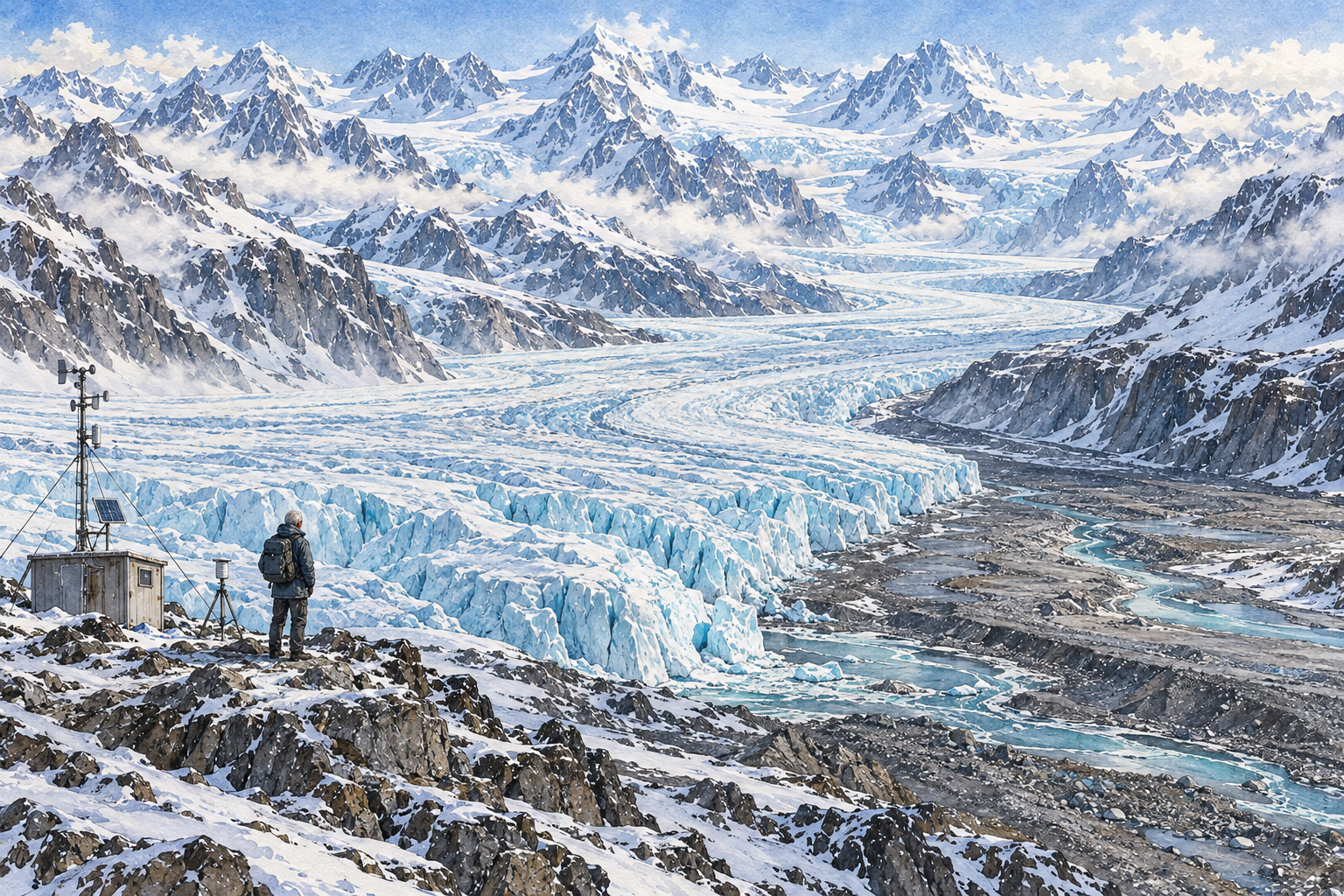
At the World Climate Congress, Elias showed the measurements and the limits of what they could yet establish. His estimates included wide ranges. He was confident about the direction of the change, less certain about its speed, and unwilling to predict what entire societies would do in response.
A reporter caught him afterward in a corridor outside the lecture hall.
“What does it mean for ordinary people?” she asked.
Elias was thinking of the freight roads, the settlements on frozen ground, and the boy who had fallen through thin lake ice near his hometown the previous spring.
“Our grandchildren may inherit a world very different from ours.”
He meant it as an observation. The world turned it into a warning.
Within a few years, other researchers had confirmed the warming. Evidence also showed that the fuels used to heat northern cities, power industry, and keep vehicles running through the long winters were adding heat-trapping gases to the atmosphere. The engineering that had made life on ice possible was helping to change the climate beneath it.
Governments had good reasons to respond. Cleaner power plants reduced the smoke that used to hang over Elias’s city in the coldest months. New heating systems burned less fuel. Regulations discouraged needless emissions. Elias testified in favor of several of them, although he argued against a proposal that would have left remote villages without affordable transport.
Years later he noticed a different sort of change. At a meeting to set environmental targets, a minister pointed to a map of the ice sheet as it had stood at the end of the previous century.
“We need a number the public can understand,” she said.
The map was clear and the survey data were good. No one in the room could say why that particular decade was the right condition for the planet to maintain, but it offered something to measure. The chosen ice extent became the official reference. Then the target. Eventually, in the capital letters of a thousand reports, it became the Baseline.
Elias saw it again on a school map his granddaughter brought home. White marked the historical ice cover; red marked what had been lost. Along the bottom, the legend called the red regions degraded former glacial habitat.
He had no objection to describing what was disappearing. There was plenty to grieve. Ice-dependent animals were losing breeding grounds. Water supplies had become less predictable. Houses built on frozen soil were shifting on their foundations. But he held the map a long time, looking at the red areas as if the color itself had made a judgment.
The following summer, he took Mara to the mountains.
* * *
She was nine, old enough to read the warning signs on the crawler and young enough to press her face against its window for most of the ride. Elias brought her to the valley where he had kept his first observation station. The glacier had retreated so far that they could see the old instrument tower long before they reached it.
“That’s where you used to work?” Mara asked.
“When I had better knees.”
“It looks broken.”
“It may be.”
He parked beside the tower. Its ladder had rusted loose at the bottom, and a wire cable clicked against the metal whenever the wind shifted. Ahead of them lay a broad floor of gravel and muddy pools. Meltwater ran through the stones in several shallow channels. Far up the valley, between two dark mountain shoulders, a piece of the glacier still showed.
Mara had seen photographs of its former size. She stood at the edge of the crawler’s track, trying to fit the old picture over the place in front of her.
“They said this used to be beautiful.”
“It was.”
“It’s ruined now.”
Elias looked at the stream, the boulders and the torn edge of ice in the distance. He could have corrected her. Instead he asked if she wanted to walk farther.
They followed the water. The ground sucked at their boots. When Mara stopped to shake mud from one heel, she noticed a patch of green between two stones. Three yellow flowers stood above it, each hardly taller than the toe of her boot.
“Grandpa, come here.”
He crouched beside her. The flowers were small, five-petaled and battered on one side by the wind. One had bent almost flat, then turned upward again.
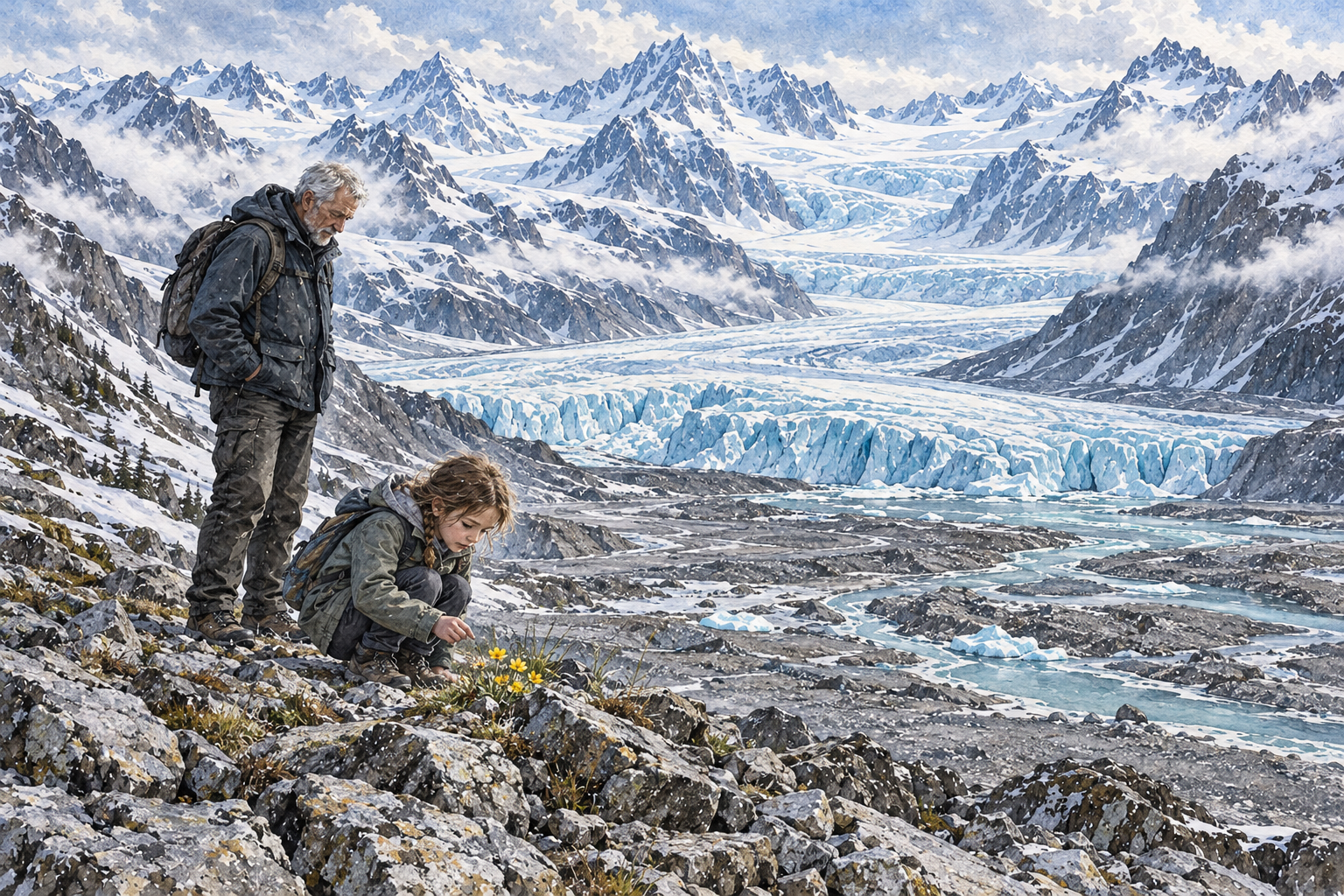
“Who planted them?”
“No one, as far as I know.”
“Are they supposed to grow here?”
Elias nearly said no. He had spent his working life studying a glacier whose absence was now visible everywhere he looked. At school Mara had been taught that changes in habitat put native species at risk, and she was right to be concerned.
He touched a leaf with one gloved finger.
“Apparently they are.”
Mara frowned. “But what if they’re the wrong kind? We learned about plants that take over.”
“We’d have to find out what they are first.” He took a close photograph, using his glove as a scale. “And whether anything is already living here that they’d crowd out.”
She nodded, not fully persuaded. On the way back she kept turning to look at the patch until the stones hid it from view.
For years afterward, Elias would find photographs of that trip whenever he needed them least: the rusted tower, Mara with mud up both legs, and three yellow flowers growing where his old maps showed solid ice.
The valley changed faster than his early forecasts had suggested. Moss took hold along the streams. Low shrubs spread across the gravel bars. Trees appeared first in sheltered pockets and later along the slopes. Their roots found thin soils where snow and stone had been breaking down for years. Birds nested in the willow thickets. The trees did not cover every part of the valley; spring floods regularly tore young growth from the lowest ground.
Elias lived long enough to see the first grove from the old observation station. He died before its trees rose above the tower.
Mara became an ecologist. She visited the valley often, at first out of affection for her grandfather and eventually because it was an unusually complete record of a changing landscape. The surviving field notebooks told her what had lived there before, and the new surveys showed which creatures had arrived. Sometimes she went home troubled by how easily people mistook one kind of evidence for the whole picture.
She spent a summer farther north studying white seals that gave birth on seasonal sea ice. One spring the ice broke apart weeks too early. Mara watched a mother circle the open water where her pup had last been, surfacing again and again in the same patch of gray sea. The research team searched until the light was gone. They found nothing.
After that, she had little patience for anyone who called the warming harmless.
Her agency produced careful assessments of habitat loss, coastal flooding, food production, and the costs of moving settlements. They were useful reports, and many of their warnings proved right. Still, a phrase in one of them bothered her. A new forest in her grandfather’s valley was described as vegetation encroachment. A nearby loss of tundra was called habitat destruction. Both descriptions had meaning. Set side by side, they made it hard to see the valley as anything other than an absence.
She wrote a note in the margin: What are we measuring against?
During the next assessment, she took a question to an economist named Imani Rell, who kept three screens of land-use models running on her desk and had a habit of chewing the ends of pencils.
“How much value have we assigned to the areas emerging from the northern ice sheet?” Mara asked.
Imani turned one of the screens toward her. “More than we used to. Some regions may support grazing, timber or crops. Others won’t.”
“What about a valley with a reliable river and access to the coast?”
“I can give you six outcomes. Three would lose money for a century.”
Mara sat down.
Imani brought up a map. “There are places where newly exposed ground is mostly unstable rubble. Soil takes time. Roads need bridges. Ports need harbors, not just shorelines. We don’t get a new city for the price of a patch of grass.”
“I know. I walked across some of that rubble when I was nine.”
“Then you know why I’m cautious.”
Mara pointed to a pale region near a future river mouth. “And if people find a way to make this useful in fifty years? Or a hundred?”
“We run scenarios. Some include that possibility.” Imani clicked through two charts. “But the range is enormous. The costs to protect an existing harbor are fairly well known. The value of a harbor no one’s built yet depends on people moving there, the water staying navigable, and a dozen other assumptions. Put one hopeful estimate in the summary and it begins to look like a promise.”
“Then the summary tells us what we might lose in dollars, and gives us a footnote for what we might gain.”
Imani stopped chewing her pencil. “Sometimes. It also leaves out losses we can’t put a fair price on. Ask the families moving away from the seal coast.”
Mara thought of the empty water where she had last seen the mother seal.
They worked through the table together. Some possible benefits were included. Others appeared only in distant scenarios, diminished by long time horizons or excluded from headline totals because they could not be estimated with confidence. Some losses suffered the same problem. By evening Mara understood why the model looked the way it did. She also understood how easily a reasonable method could turn into a public story that sounded more certain than the numbers deserved.
When she left, Imani called after her, “If you want to fix the summary, help me write one people will actually read.”
Mara did.
* * *
The argument became less academic when Northhaven’s oldest road began to buckle.
Northhaven had been built beside the Halden Glacier. Its drinking water came from the ice, and its hotels, rail yards and warehouses owed much of their existence to the frozen landscape. Its oldest neighborhoods stood on permafrost, which had been a solid foundation for generations.
Now pipes pulled apart underground. Doors jammed as the walls beneath them settled. A school closed one November after a crack opened through the gymnasium floor.
At first the city repaired the damage as it always had. Then it covered vulnerable sections of the glacier with reflective fabric, trying to preserve a dependable meltwater source and the ice face tourists came to see. Snowmaking crews worked through the coldest nights. Refrigeration loops were buried under three blocks of the historic center, where the city hoped to keep its landmark buildings level.
The equipment helped. The bills grew. One winter the cooling system failed during a warm spell, and emergency repairs consumed the money set aside to replace a bridge on the east side.
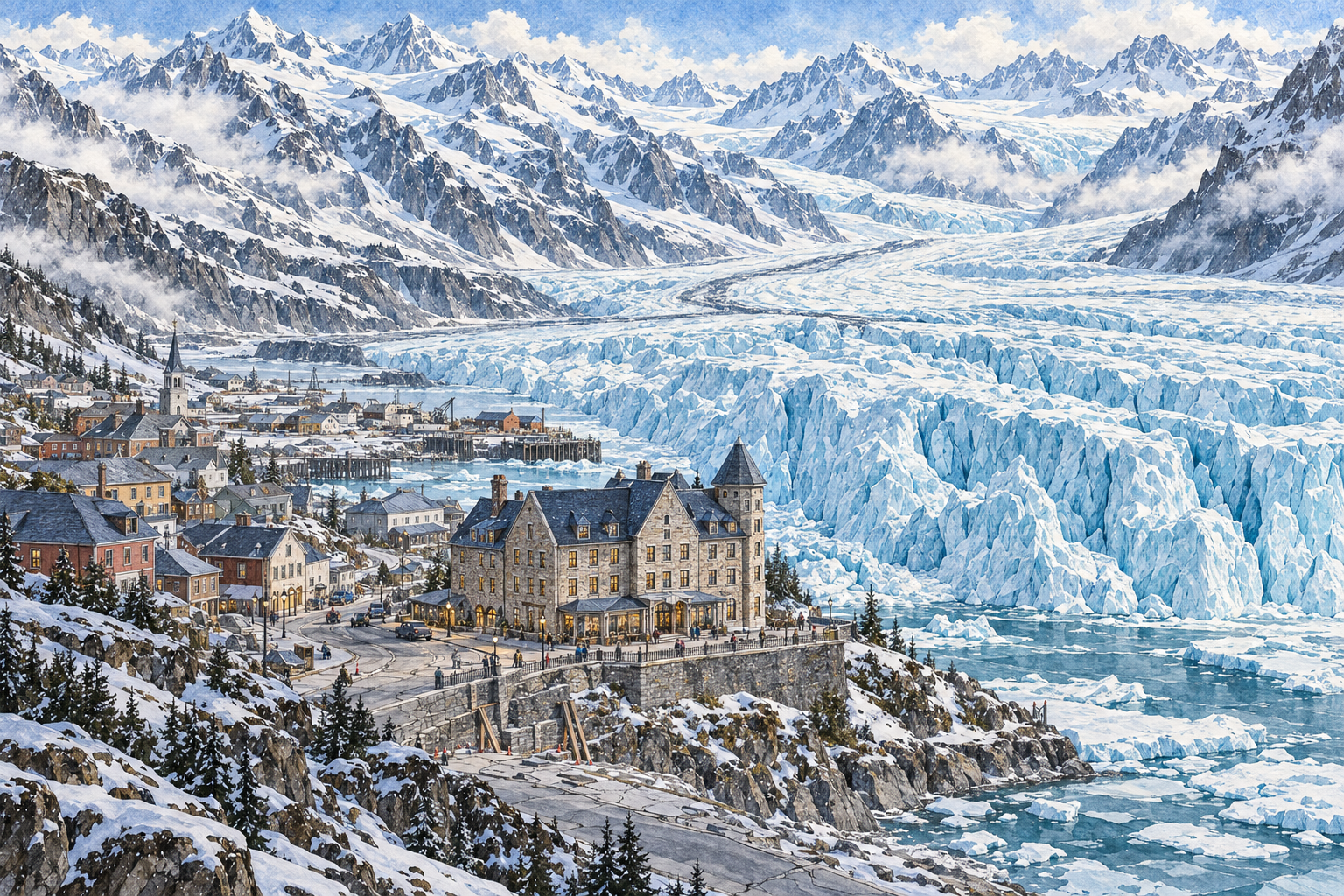
Tomas Vale, a young civil engineer employed by the city, put two maps before the council. The first showed the places where pipes had broken in the previous ten years. The second showed a ridge of stable bedrock several kilometers away, with a road corridor that could reach it and a river basin that might supply water after treatment and storage improvements.
“I’m not proposing that everyone leave tomorrow,” he told them. “We have buildings that will last another forty years and others that won’t last five. When a school needs replacing, build the new one on the ridge. Extend the water line there. Move the maintenance depot when its lease expires. Give people a place to go before they have to go.”
He proposed a phased plan with public housing, transport links to the old city, and money for residents who could not afford to move. He also said the water project would require a new reservoir and a treatment plant, neither cheap nor certain to receive approval.
The hearing room was full. A woman named Anna Kest, who ran a bakery on the old main street, brought a folder of property assessments. Her husband had inherited the building from his father.
“You can draw a new street on a map,” she said. “I can’t move my ovens with a pencil. If the council announces the old district is finished, who’ll buy my property? Who’ll lend me money for a new shop?”
Tomas had an answer about grants and staged tax relief. He gave it badly. Anna shook her head before he finished.
An older man rose from the back and asked what would happen to the cemetery. Another wanted to know why his neighborhood had been left off the first phase. A mother asked whether her daughter would have to spend two hours a day on a bus to reach a new school. Tomas had been so absorbed in drawing a workable city that he had not expected quite how many different Northhavens people were afraid to lose.
Then Councilor Dain leaned into his microphone.
“The public hired you to protect this city, Mr. Vale. Are you telling us to surrender it?”
Tomas looked toward Anna, still holding her folder on her lap.
“I’m trying to save the people who live here,” he said. “I’m less sure I can save every street.”
The council rejected his plan. His supervisor called him in the next morning and told him the mayor no longer had confidence in his judgment. Tomas cleared his desk after lunch. He took the ridge maps home rolled under one arm because the tube had belonged to the department.
Northhaven kept shifting anyway.
An apartment developer bought land along the bedrock road. A repair company moved its workshop there after flooding ruined its machinery for the third time. Families who could afford to sell avoided houses with visible foundation cracks. The first new school was built near the ridge when an insurance company refused to renew coverage on the old one.
The city eventually adopted a version of Tomas’s corridor plan. It came without enough relocation assistance. Families with savings moved first; renters and older residents were more likely to remain among failing pipes and intermittent heating. Anna held on to the bakery until a second broken water main closed her block for six weeks. By then the promised small-business loans had been spent.
“They’re moving the town one invoice at a time,” she told a reporter. She was furious, and she was right.
Thirty years after the hearing, the ridge had a hospital, a freight terminal, schools and crowded neighborhoods. The water system drew from upland tributaries through a new reservoir; dry years still brought restrictions. Northhaven had survived, though the transition had been less orderly and less fair than any of the plans described.
The old center survived too, in a way Tomas had not expected. As the Halden Glacier retreated into the mountains, a long lake filled part of its former valley. Kayakers arrived when the water became navigable. A summer guide took visitors beneath an old steel sign that still warned against crossing the ice. The glacier hotel kept its broad front windows. Guests who once paid to look at a wall of blue now watched evening light settle on forested slopes and waterfalls.
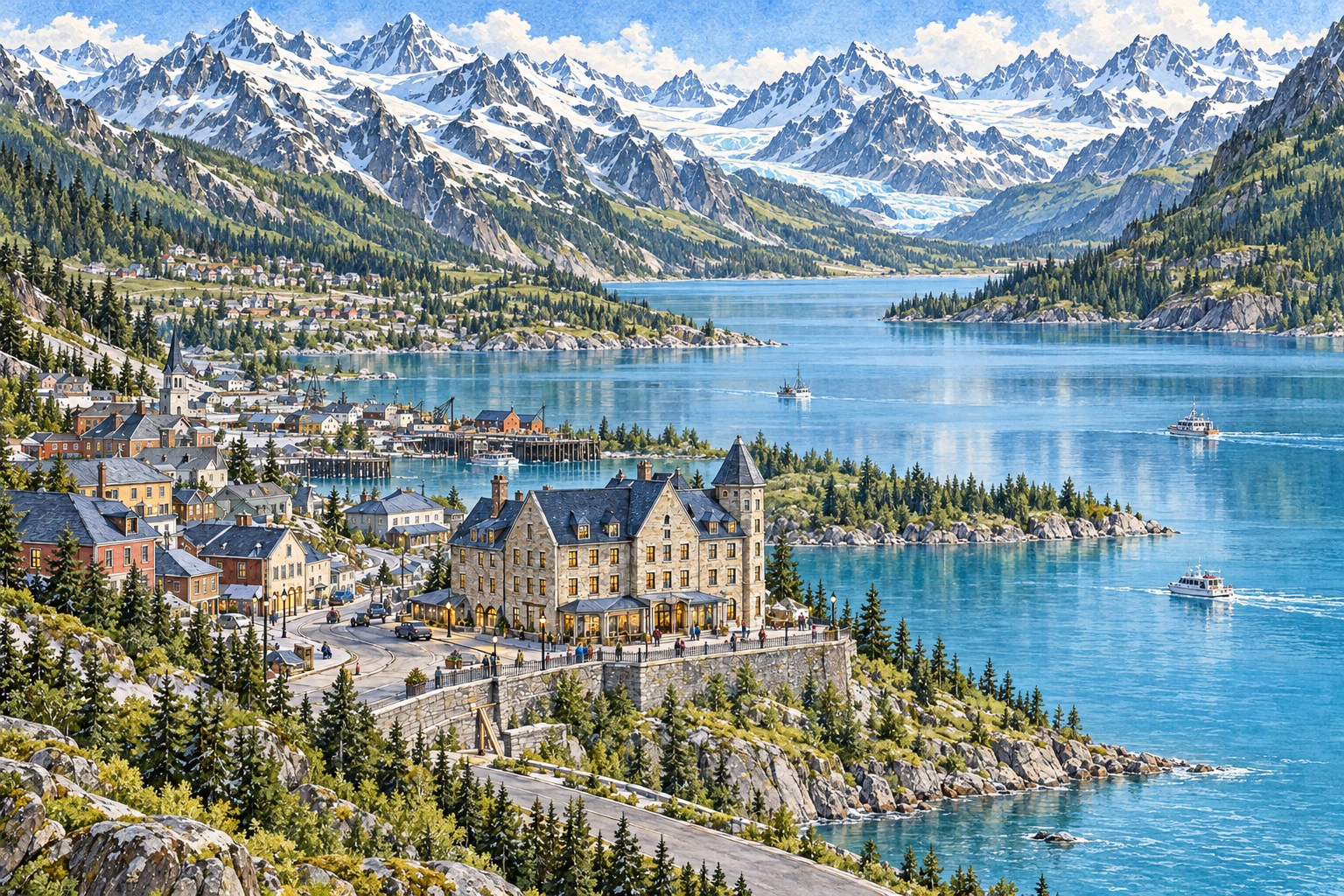
Some streets remained empty. Anna’s building had been demolished. Elsewhere, small businesses reopened in old storefronts, and seasonal workers came looking for rooms. Neither the city’s early forecasts nor Tomas’s plan had imagined that particular mixture.
On a visit to Northhaven, Mara met Tomas at the hotel’s dining room. His hair had gone white. Across the lake, the sun was shining on bare rock that had been hidden under ice when he was young.
“I thought this whole district would be abandoned,” he said. “The ground was failing. The jobs were leaving. I was certain of it.”
“Now people come here for their holidays.”
“In summer. In winter half the shops close. But yes.” He watched a tour boat turn slowly below the terrace. “I got the engineering problem mostly right and the people problem only partly right.”
“You spent twenty years telling them the city would change,” Mara said.
“Yes, and then it changed differently from the way I told them.”
Mara smiled. He was watching the boat and did not notice.
* * *
During Mara’s lifetime, the warming reached places that had never appeared on the first maps Elias showed at the Congress. Some coastal villages were abandoned after repeated flooding. Ancient winter routes became dangerous. Species lost the seasons they needed to breed, feed or migrate. People who had done little to contribute to the change often had the fewest resources to respond.
Other places became possible to inhabit. Forests moved north. In some regions farmers gained longer growing seasons; in others, newly thawed ground drained poorly or remained too unstable to work. Rivers uncovered new routes into the interior. Settlements appeared at the edge of old ice maps, near ports, roads and timber stands that had been impossible a generation earlier.
The gains did not arrive on the same doorstep as the losses. A fishing family forced to leave its coastal village could not pay for a new home with the value of a distant harvest a century away. The seals Mara had studied gained nothing from a northern town’s prosperity. She said this plainly whenever someone quoted her research as proof that a warmer world was better.
She grew equally uneasy with claims that all new landscapes were damaged ones. The valley where she had found the flowers had become a living place with its own species, floodplain and cycles of growth and decay. She knew what had been there before. She knew what was there now. Both were real.
Late in her career she was invited to speak at the World Climate Congress, in the hall where Elias had once presented his measurements. The organizers had sent her a list of questions on emissions targets, relocation finance and regional risk. She answered them as carefully as she could. Then she showed two photographs.
In the first, the valley from her childhood was mostly rock and mud, with the glacier still visible at the head. The abandoned instrument tower stood crooked beside the track. In the second, taken from almost the same position, trees covered much of the valley floor. A river passed through a patchwork of forest and farmland before reaching a lake with a small town along its shore. There were eroded banks in the foreground where spring floods had defeated the first attempts at planting. The tower was gone.
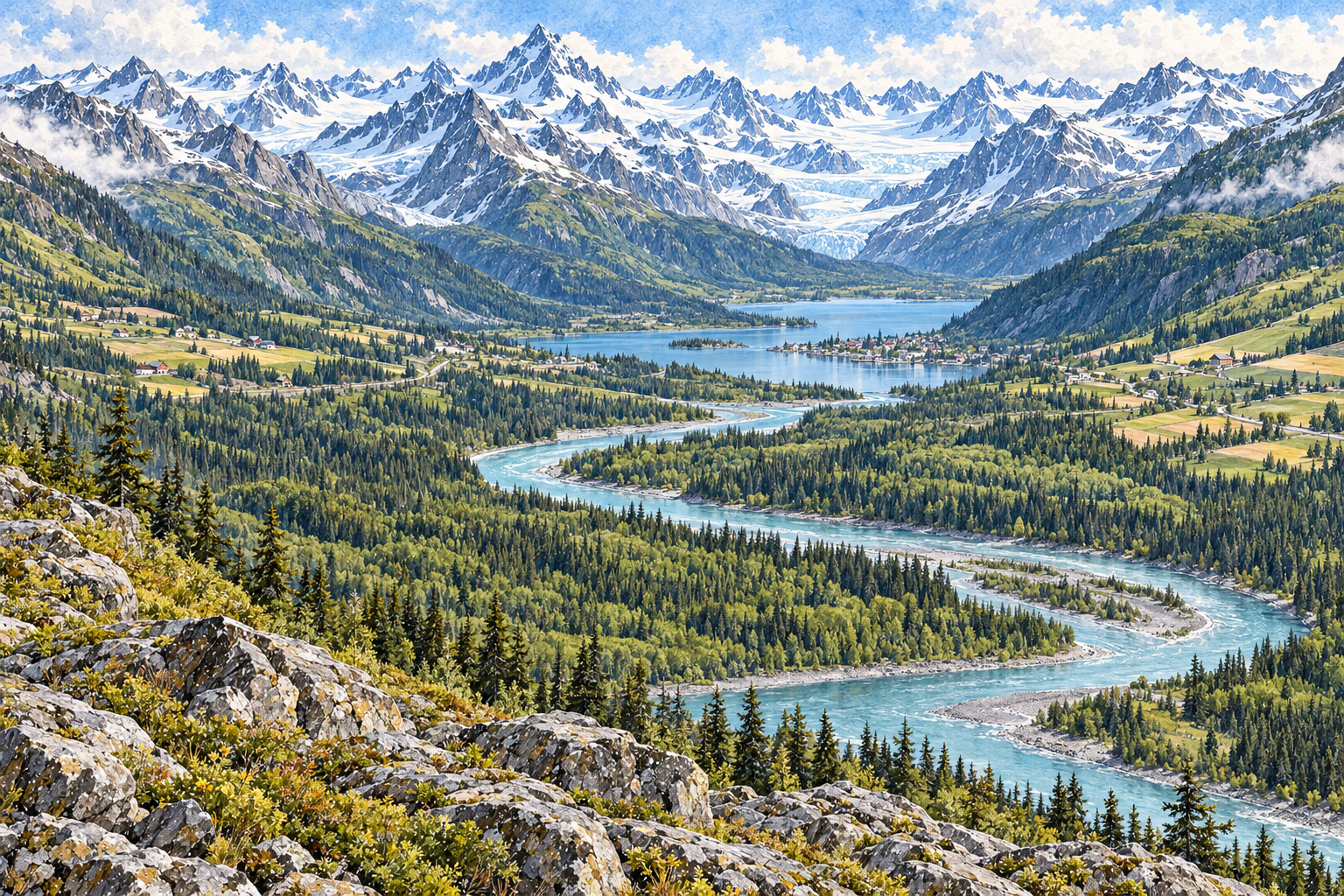
“My grandfather brought me here when I was nine,” Mara said. “I called it ruined. I was repeating what I’d been taught, and I meant it. I had seen the old pictures. I knew what was missing.”
She paused on the second image. A single yellow mark showed where she remembered finding the flowers.
“I still miss the glacier. It was magnificent. When I look at the first photograph, I miss him too.”
An ecologist in the front row stood to speak. He had spent much of his career helping species whose ranges had contracted too quickly for them to move.
“These forests are impressive,” he said. “But do you worry that we give too much credit to the species that manage to arrive? The ones that died out don’t get to appear in your second photograph.”
“Yes,” Mara said. “More than the photograph can show. Some species had nowhere else to go. I don’t think their loss is canceled by new trees.”
“Then what are you asking us to change?”
She considered his question. The room had gone quiet enough that she could hear a door closing at the back.
“When we decide what to protect, I’d like us to be honest about the cost of protecting it. When we decide what must change, I’d like us to be honest about who pays. And I’d like us to leave room in our forecasts for the possibility that new places may come to matter to people in ways we haven’t measured yet.”
“The glacier was a natural ecosystem,” he said.
“Of course it was.”
Mara turned toward the forest in the second photograph.
“So is this.”
The discussion that followed lasted well beyond the scheduled hour. Some delegates heard an argument for reducing emissions more aggressively, while others heard a case for spending more on adaptation. Mara found herself correcting both groups. She wanted fewer children to watch the things they loved disappear. She also wanted them to have places to live if those things disappeared anyway.
There was no single policy that settled the matter. Governments continued trying to limit the warming where they could, and learned, unevenly, to spend more on relocation, water systems, changing agriculture, and habitats that could no longer be kept as they had been. Some communities defended their old sites for generations. Others moved early. Some made the wrong choice and had to make another.
The maps kept changing.
* * *
Nearly four centuries after Elias Venn warned that his grandchildren might inherit a different world, a school group visited the Museum of the Glacial World. It stood in the valley where Mara had once found the three yellow flowers. Behind it grew a forest, older than the museum itself.
The children wandered among enormous photographs of glaciers, sleds and icebound railways. An old film showed trucks crossing a frozen lake in a winter convoy, their headlights stretching toward the horizon. A boy wondered why they hadn’t built a bridge. His teacher explained how much cheaper the ice roads had been, and how dangerous they became when the winters changed.
One girl lingered in front of a photograph of the valley before the retreat. The glacier reached nearly to the spot where the museum now stood.
“All of that was ice?” she asked.
“Yes,” the teacher said. “Most of it.”
The girl studied the picture, then went to the window. A breeze had stirred the high branches, and sunlight moved across the floor in broken shapes.
“Did they know these trees would grow?”
“Some scientists expected forests eventually. They couldn’t say exactly where or when.”
“Would they have liked it?”
“Some would. Some had lost too much to feel pleased about it.”
In another room, an exhibit asked visitors to consider the planet’s distant future. It described a highly uncertain possibility: a sustained reduction in sunlight far beyond the normal solar cycles, lasting long enough for snow and ice to amplify the cooling. The display made clear that this was a thought experiment, not a prediction. A model showed winters lengthening over many centuries, forests retreating, and glaciers growing in the high valleys again.
The children watched the simulated snow reach the museum’s hillside.
“What happens to the farms?” someone asked.
“And the animals?”
“They’d have to move,” said the teacher. “If it happened.”
“We couldn’t let it,” a boy said. “We could put more heat in the air.”
Another suggested mirrors in orbit to bring more sunlight to the north. A third wanted a wall to stop the glaciers. The teacher asked where the wall would go, and the class argued happily for a while about the strength of concrete.
The girl by the window said nothing. She had been born in a town among trees. She knew the smell of the forest after rain, the slippery path to the river, and the place where her family gathered berries each summer. She tried to put a glacier into that picture, covering the path and the river and the trees.
She could not.
When the teacher called the class together, the girl raised her hand.
“If it really started getting colder,” she asked, “how would we know which things to save?”
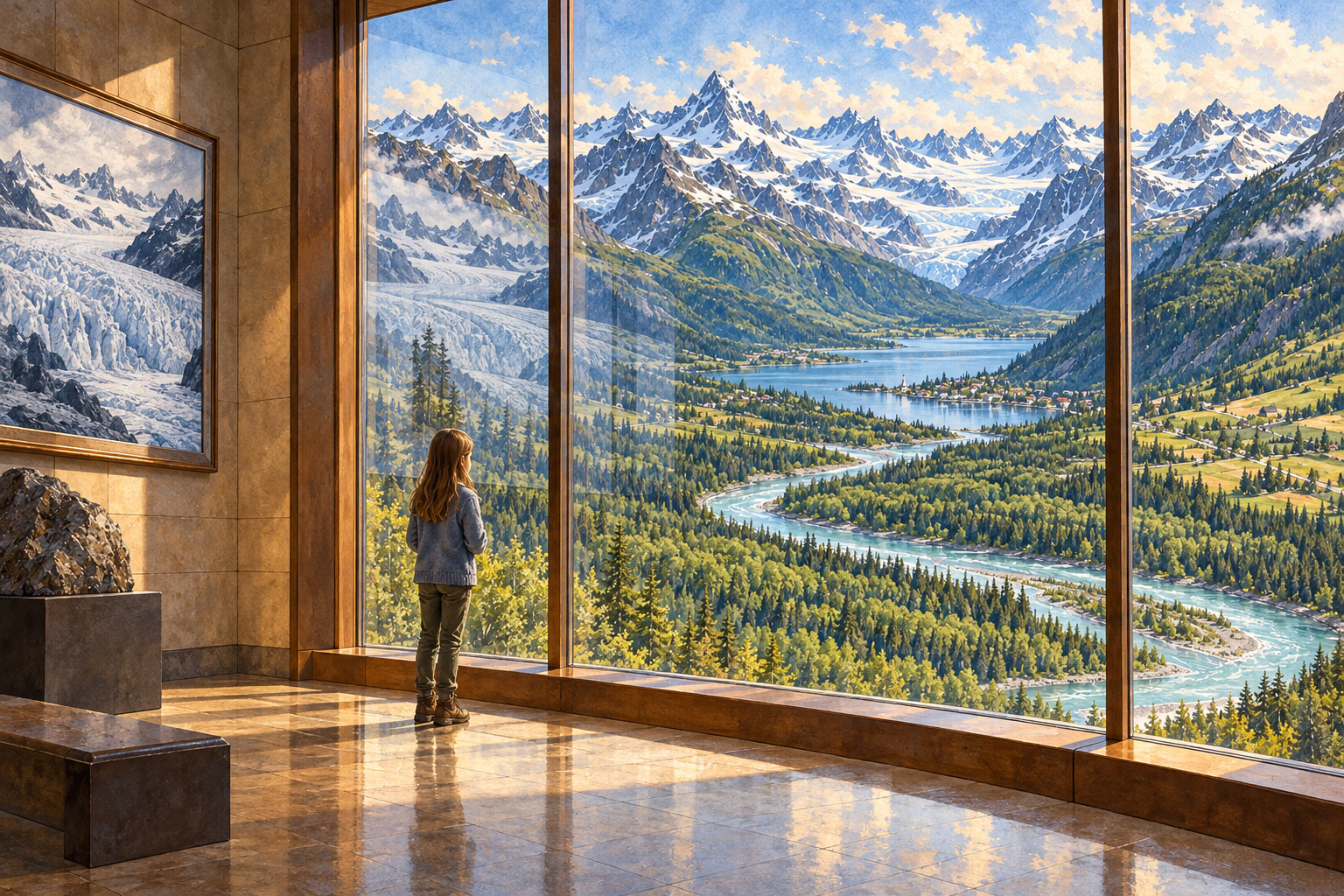
The teacher looked toward the trees outside. A few yellow leaves had begun to fall, though winter was still weeks away.
“I don’t think we’d all agree,” she said.
The children stood a moment longer at the window. Then someone called from the hall that the bus was ready, and they went to get their coats.
Author’s Note: Why I Created After the Ice
I created After the Ice because I believe we need a broader, more thoughtful conversation about climate change and how humanity should respond to it.
Much of today's discussion focuses on stopping or slowing climate change and preserving the world as we know it. I understand why. Climate change is real, and its consequences can be serious. Communities, ecosystems, and entire ways of life may be threatened. Efforts to reduce those risks deserve careful consideration.
But I keep coming back to another question: Are we giving enough attention to preparing for and adapting to a changing world?
My background in science has taught me to respect evidence, recognize uncertainty, and question assumptions. Earth's climate has never been static. While change inevitably brings losses, it can also create opportunities that are difficult to anticipate or measure today.
I also believe we need to be realistic about the world's continued dependence on fossil fuels, the economic consequences of our decisions, and the different capabilities of nations to respond. Resources are limited, and how we choose to spend them matters.
That thinking led me to imagine a world where enormous glaciers are considered the natural, ideal condition of Earth. When the ice begins to retreat, people understandably fear what they are losing. Yet over time, forests, rivers, wildlife, and new communities emerge.
Would people recognize the value of that new world? Or would they remain so focused on preserving the old one that they struggled to appreciate what was developing?
My goal is to encourage readers to question how we define environmental progress and what it really means to protect our planet.
I am not suggesting that climate change is inherently good or that efforts to reduce its harmful effects are misguided. I believe we should examine the full range of possible responses, including reducing emissions, developing better technologies, protecting vulnerable communities, and investing in adaptation.
Most importantly, I hope this story encourages genuine discussion among reasonable people who may disagree about the best approach.
If readers finish After the Ice questioning a few of their assumptions, considering perspectives they might previously have dismissed, and thinking more openly about humanity's ability to adapt, then the story has accomplished what I hoped it would.