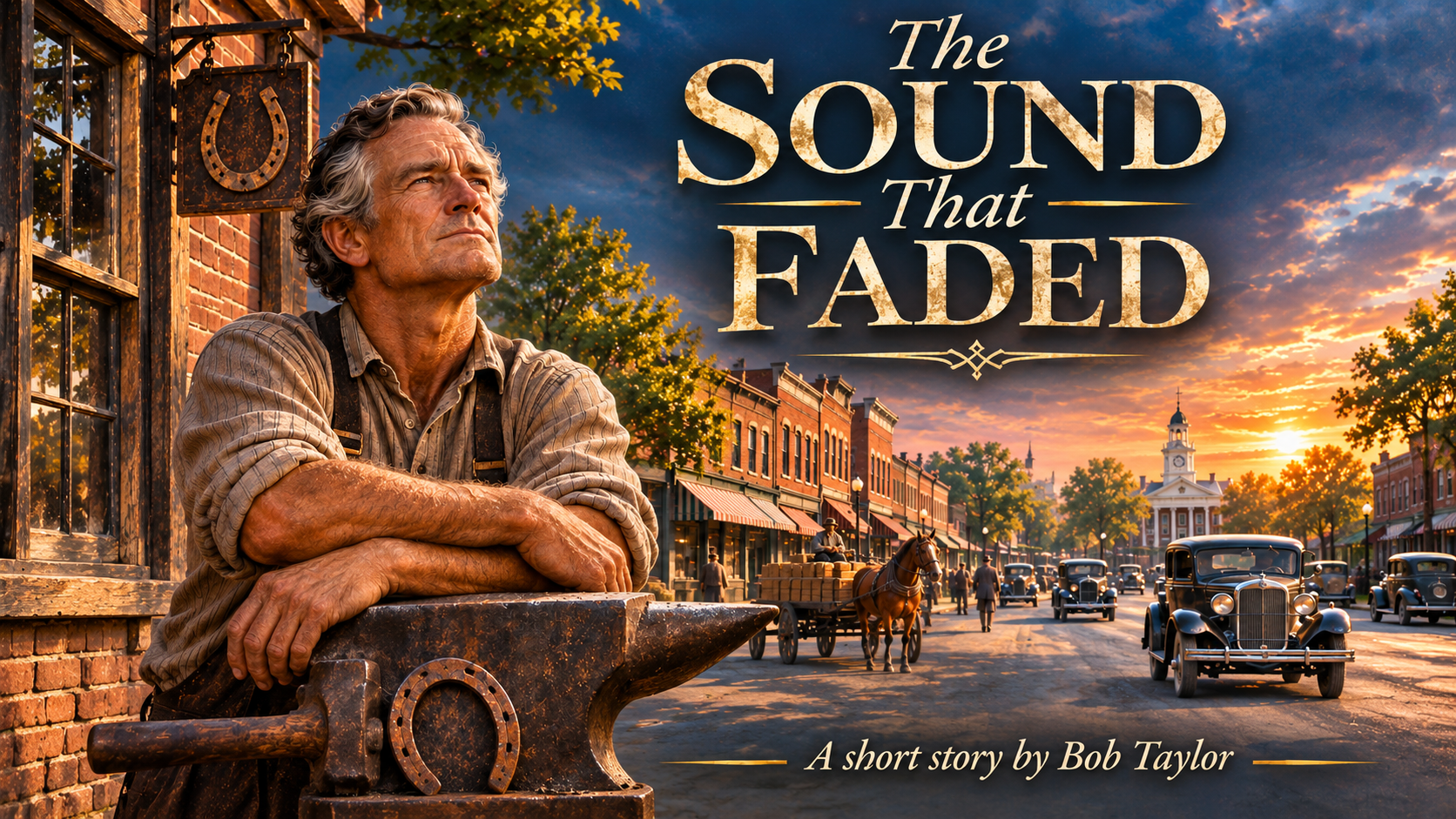
Even after forty years, Samuel Reed could tell the temper of a piece of iron by the color of its glow and the ring it made under a four-pound hammer.
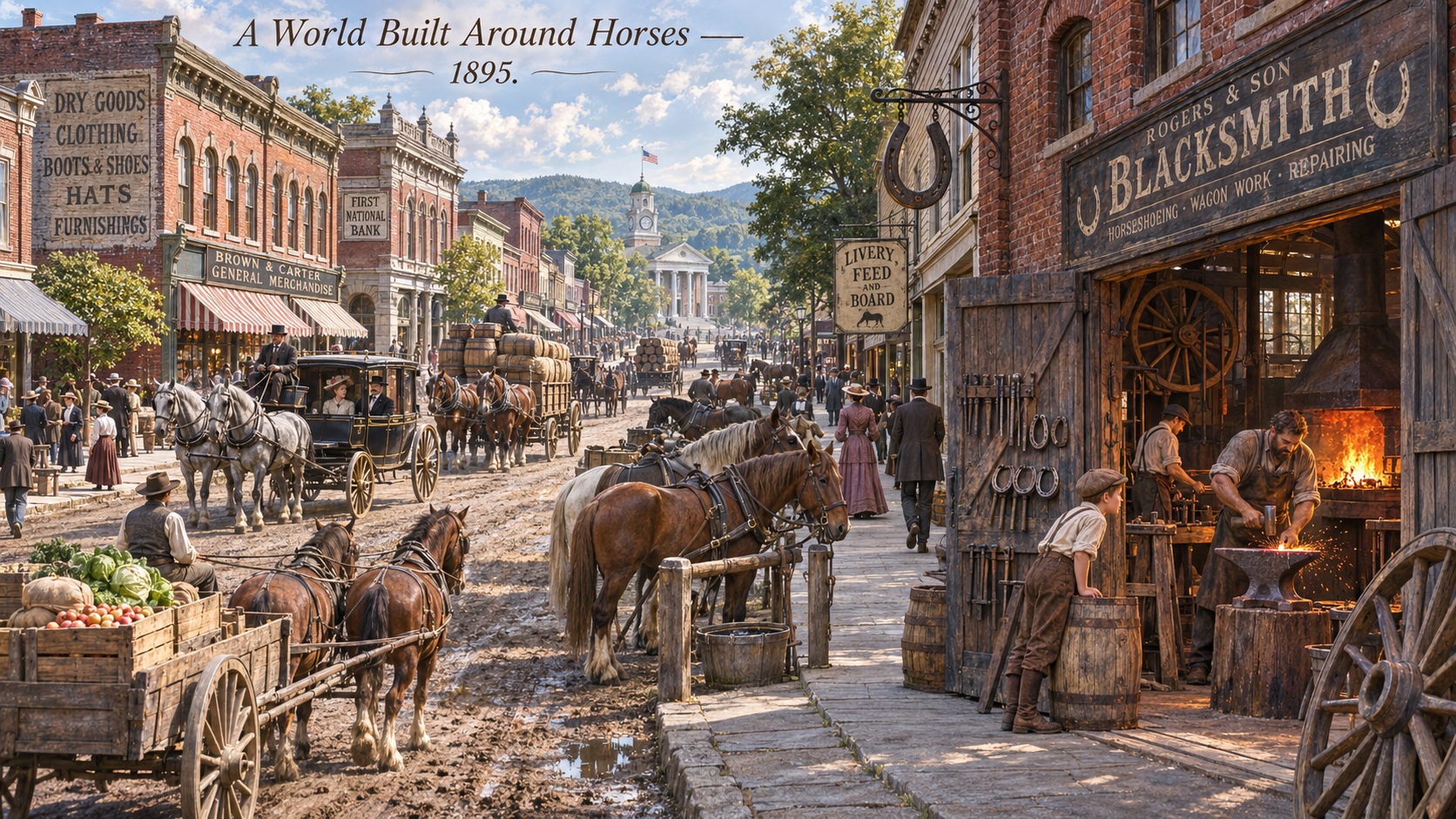
He had learned that in the summer of 1895, at fifteen, standing ankle-deep in coal cinders beside Thomas Whitcomb's brick forge on Main Street. Whitcomb was a broad-shouldered man with burns up both forearms and no patience for wasted motion. On Samuel's first morning, the old smith had shoved a pair of tongs into his hands and pointed at the slack tub.
"Iron don't care how tired you are, Sammy," Whitcomb had barked over the roar of the bellows. "You strike while she's lemon-yellow, or you go back to mucking stalls."
Samuel didn't go back to the stalls. He hauled soft coal until his shoulders knotted, learned to trim a hoof without cutting too deep, and breathed the sharp, familiar smoke of scorched horn and wet coal every day but Sunday. Outside the wide double doors, Millbrook moved at the speed of hooves—doctors' buggies, farmers' hay wagons, the lumbering drays from the freight depot—their iron-rimmed wheels and shod feet keeping a steady, clattering pulse from dawn until dusk. A boy couldn't look at a street like that and imagine a day when a good smith wouldn't be needed.
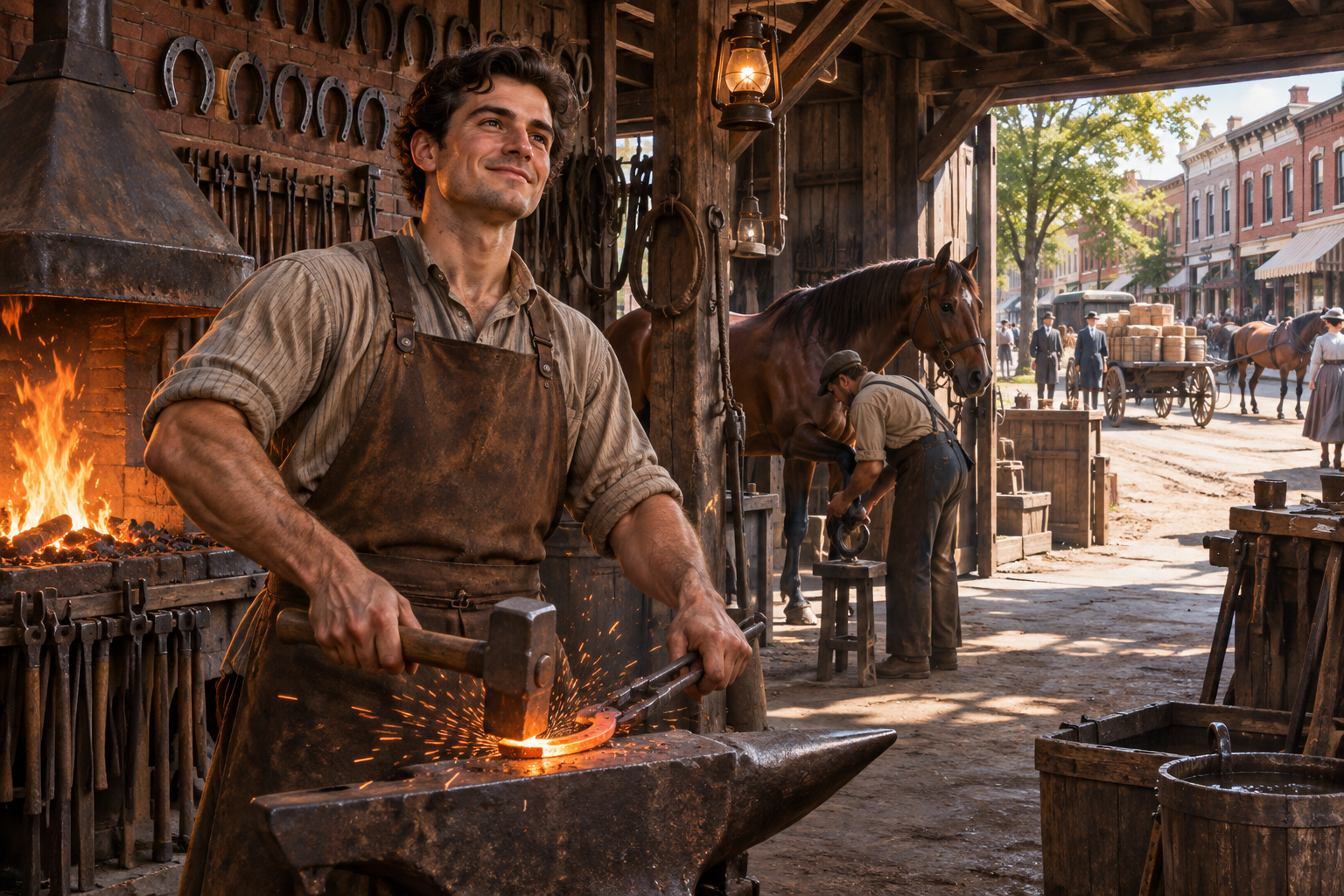
By 1903, at twenty-three, Samuel had his own shop three blocks south of Whitcomb's, bought with every dime he had saved and a three-hundred-dollar note from his father. He married Clara that October, and two years later their son, William, was born in the clapboard house behind the lot. Most mornings Samuel had the fire banked and glowing before the roosters finished crowing. Clara would walk out at noon with a tin pail of stew and sit on an upturned nail keg while he wiped the soot from his face, the two of them talking over lumber prices or William's newest tooth to the rhythm of horses stamping at the hitching rail outside.
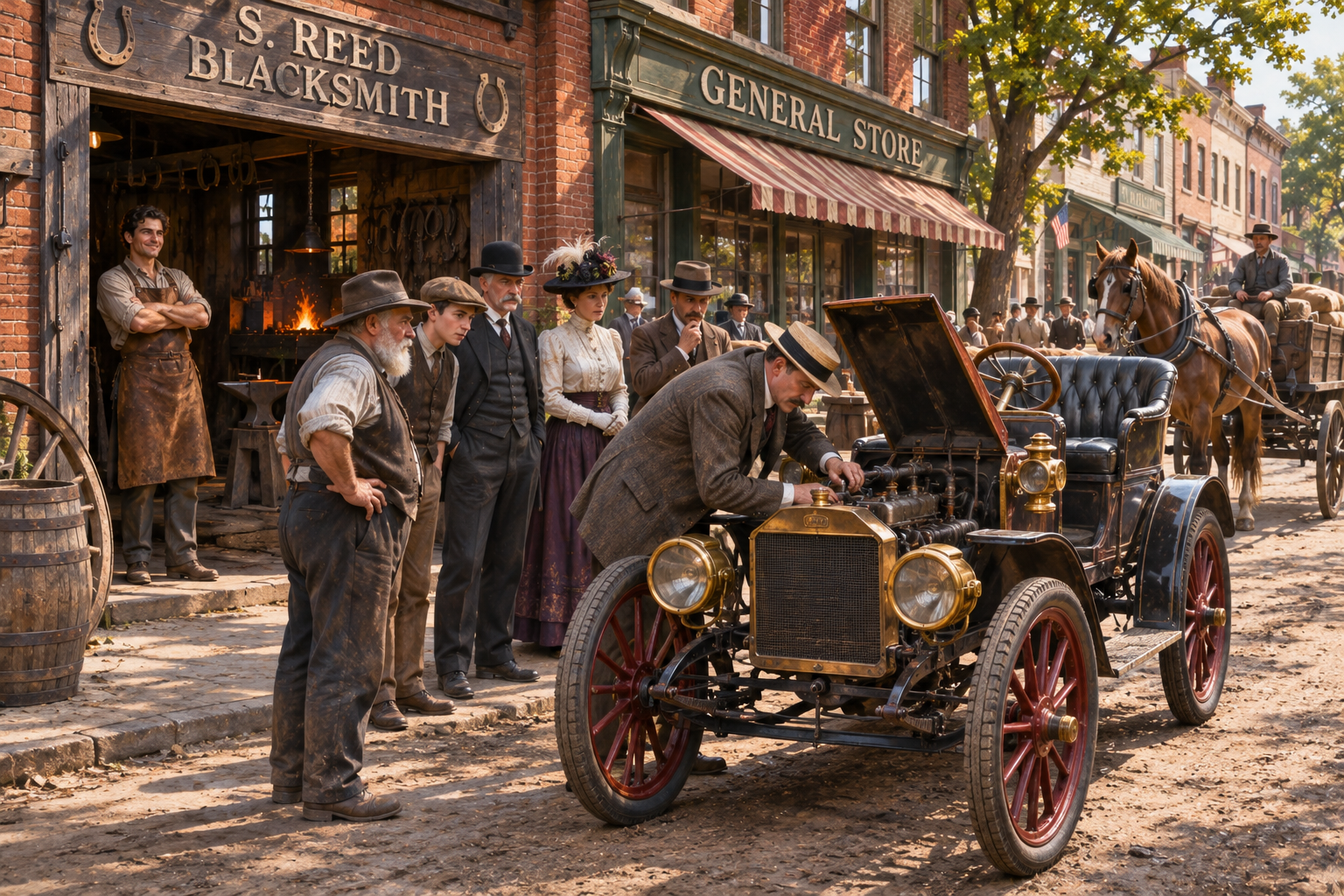
The first automobile Samuel ever saw came coughing down Main Street in May of 1906.
It was a brass-trimmed runabout driven by a timber broker from Pike County, kicking up yellow dust and popping like a string of wet firecrackers. Half the town spilled onto the boardwalks to gawk. Beside the feed store, a bay mare bolted in her traces and nearly dumped a crate of Mason jars into the gutter before Samuel ran out and caught her bridle.
He stood holding the trembling horse while the broker idled in front of the general store, bragging to a ring of men about traveling thirty miles without stopping for water or oats. Samuel watched with an amused half-smile. Then the broker climbed down to go inside, and when he came back out twenty minutes later, the engine refused to catch. For nearly two hours the man cranked that iron handle until his starched collar wilted into a gray rag and his face turned the color of a plum. When the cylinders finally sputtered alive, Samuel led the bay mare back to his shop, shaking his head. A rich man's toy, he told Clara over supper. Good for raising dust, useless in January mud.
For the next few years, the world seemed to prove him right. Automobiles remained rare curiosities, and Samuel's ledger stayed black.
Then, in the autumn of 1911, his nineteen-year-old apprentice, Daniel Mercer, stayed late after the fire was banked. Daniel had coal dust ground into every knuckle, just like Samuel, but he kept a grease-stained motoring magazine folded in his hip pocket.
"Lew Vickers offered me a spot at his garage down by the depot," Daniel said, staring at the floor. "Pays less than you do right now. Mostly patching tires and cleaning plugs."
Samuel set down his rasp. Daniel was six months shy of finishing his time—ready to earn a journeyman's wage. "Vickers fixes three cars a week, Danny. You've got a real trade right here."
"I know it, Mr. Reed. You taught me good." Daniel looked up, earnest and stubborn. "I just like the way engines fit together. Feels like where things are headed."
Samuel studied the boy's face, saw his own fifteen-year-old certainty staring back, and didn't argue. He shook Daniel's hand, wished him luck, and hired another apprentice the following Monday.
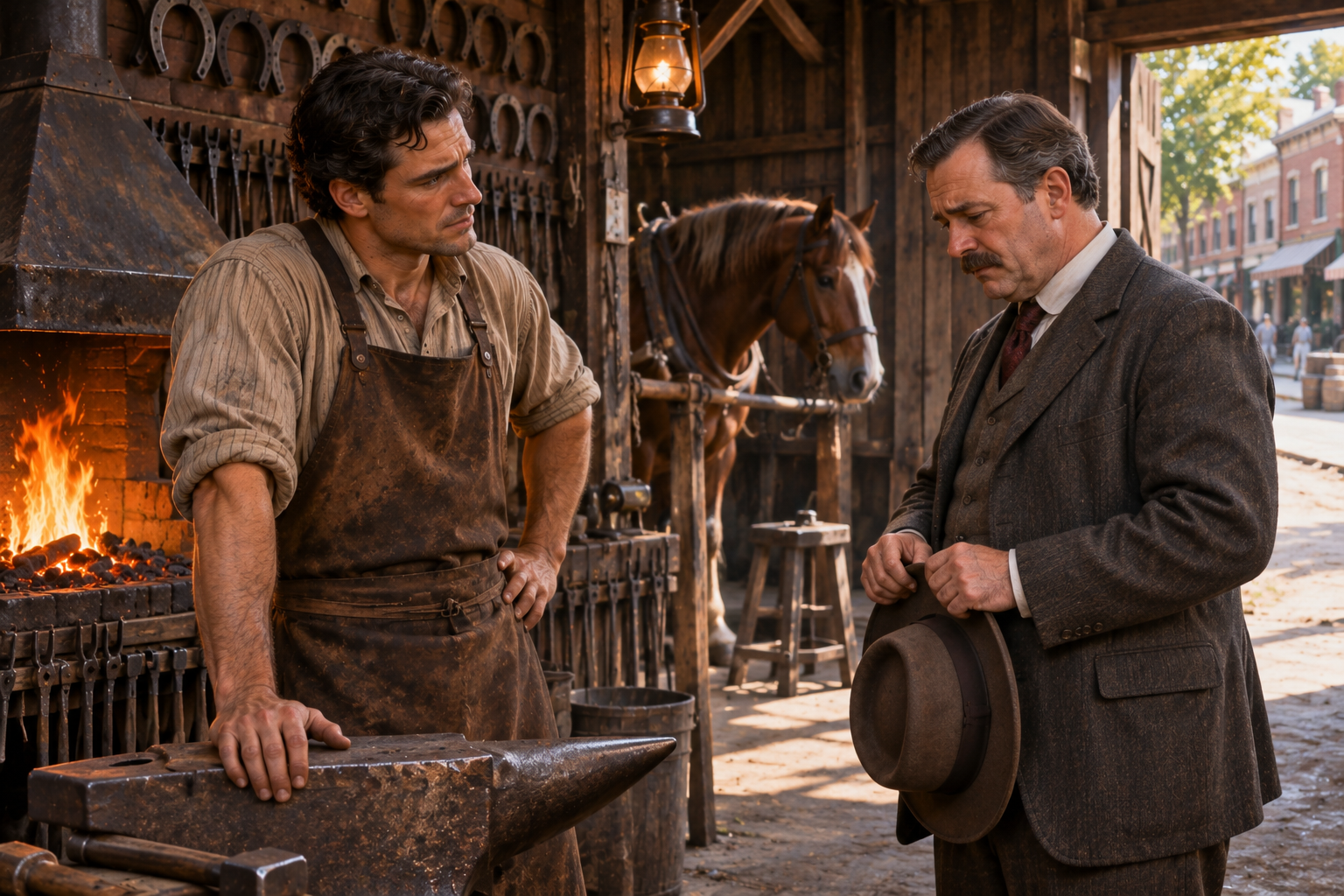
In the spring of 1916, George Harris walked into the shop during a slow afternoon. George owned the grocery on Elm Street; his three delivery wagons had kept Samuel's winter accounts steady since the shop opened thirteen years earlier, and the two men had fished the creek together since they were boys. That day, George lingered by the anvil, turning his felt hat in his hands.
"Ordered a Republic truck out of Chicago," George said quietly. "Chain-drive. Supposed to come in on the flatcar next month."
Samuel paused with a pair of calipers in his hand. "That so."
"I can reach the farms out past Ridge Road before noon, Sam. Ice stays solid, produce don't bruise, and I'm not paying feed bills on Sunday." George swallowed hard, unable to meet Samuel's eyes. "I'm keeping old Dan on for the town route. Plenty of shoeing left there."
"Sure," Samuel said, forcing warmth into his voice. "You've got three clerks and a family to feed, George. A man has to run his store."
George nodded gratefully and hurried out. Samuel had meant what he said about George's family. Even so, he caught himself hoping the truck would break down before it ever reached Millbrook. He stood by the forge until the iron he'd been heating cooled from orange to dull gray. That night at the kitchen table, Clara asked softly what losing the grocery teams would mean.
"Means I get to eat dinner before two o'clock," Samuel said, covering her hand with his. "There's four hundred horses in this township, Clara. One grocery truck isn't going to empty the streets."
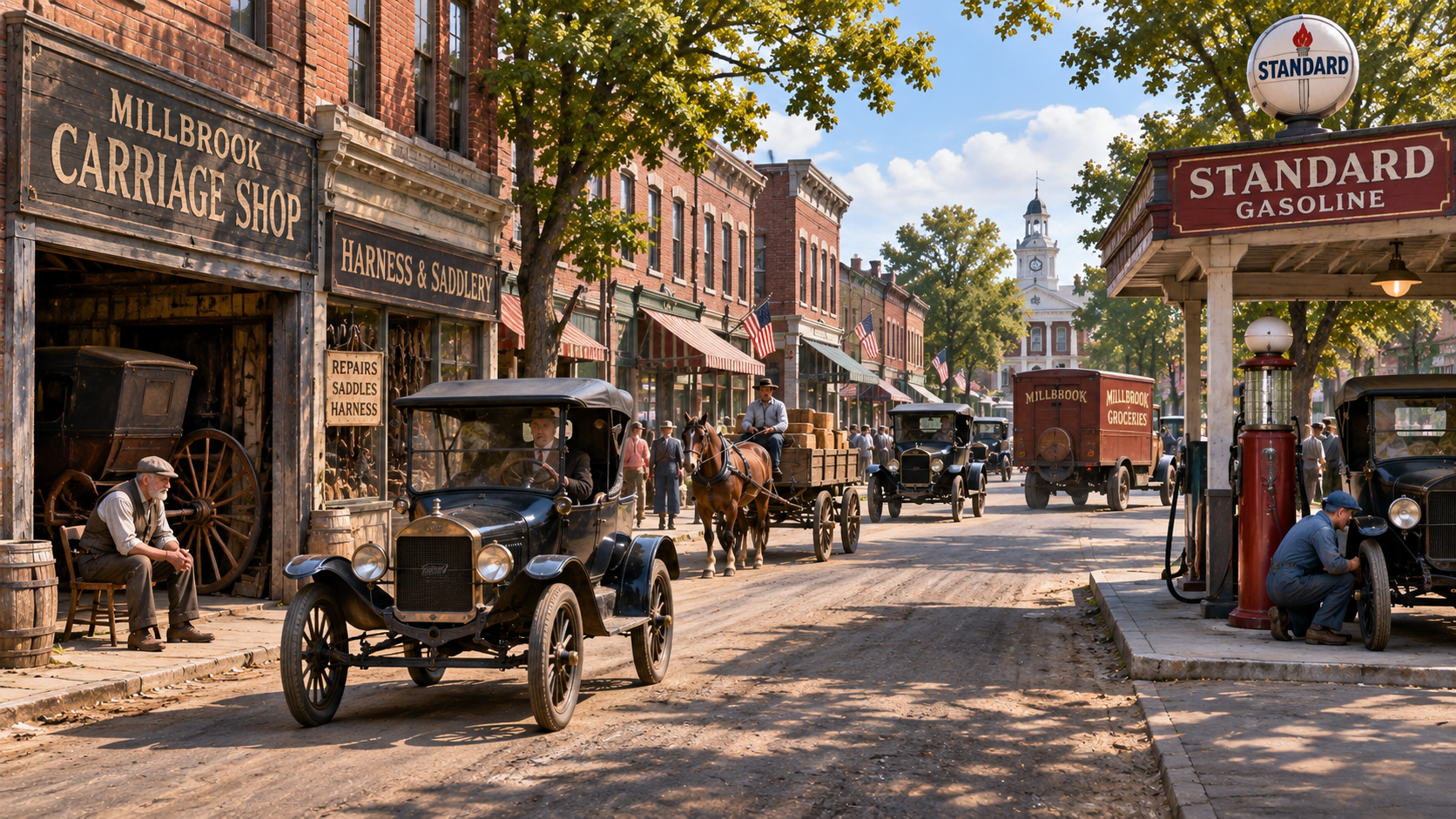
Except the bakery bought a truck that fall. Then the hardware store. By 1922, Main Street had been paved with brick, hitching posts had been pulled up to make room for diagonal parking, and Lew Vickers's old garage had been bought out and expanded by Daniel Mercer.
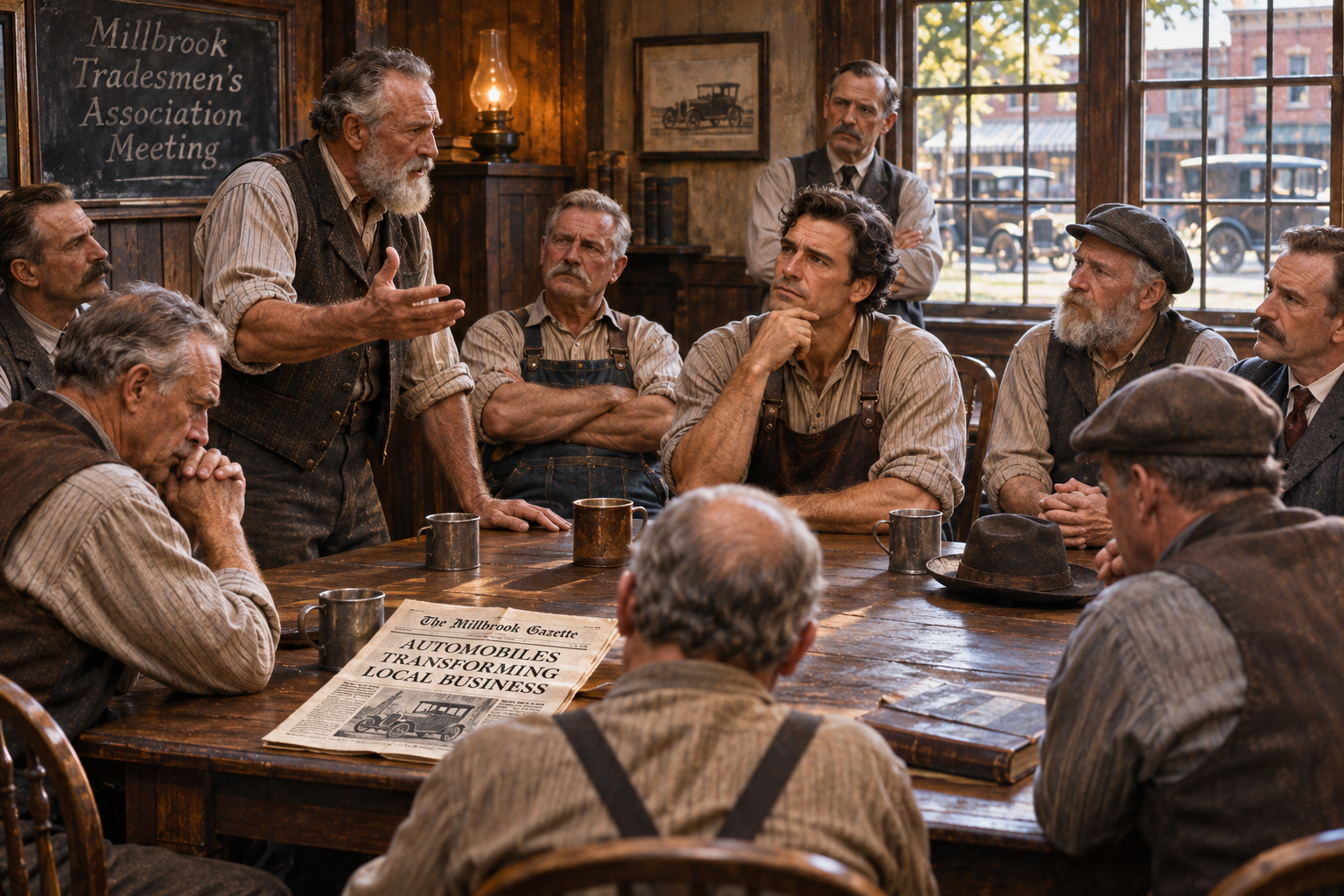
One rainy Tuesday in November of 1923, six of Millbrook's tradesmen met in the back of Edward Collins's carriage shop. A single kerosene lamp smoked on a sawhorse, throwing long shadows over men whose hands were scarred from leather awls, wood planes, and hot iron. Collins slammed his palm against a wagon wheel.
"Twenty-eight years I've built buggies for this county," Collins said, his voice hoarse. "Now half the council drives Chevrolets and wants to widen Elm Street so they can park 'em. We ought to draw up a pledge—ask folks who care about Millbrook to stick with horse delivery."
Around the room, heads nodded. Samuel sat on a nail keg near the door, feeling the pull of their anger—and the cold knot of fear beneath it. These were decent men who had built the town from mud and timber. Surely loyalty counted for something.
Collins unfolded a sheet of paper. The Millbrook Gazette, he explained, would print their pledge if enough tradesmen signed it. Samuel knew George's truck had helped his store, but he also knew how many horses no longer came through his doors. He took the pen and signed. Walter Finch put his name beneath Samuel's and declared he would never own an automobile.
The pledge appeared the following week. Beside it, a letter accused townspeople buying motorcars of turning their backs on the neighbors who had served them for years. Samuel hadn't written the letter, but he clipped it from the paper and kept it near his ledger.
The following spring, Walter Finch—who had spoken loudest at Collins's meeting—pulled up outside Samuel's open doors in a mud-splattered Dodge touring car. Finch climbed out looking like a boy caught behind the smokehouse, carrying a broken wrought-iron gate hinge.
"My wife's sister is poorly over in Ashton," Finch mumbled before Samuel could speak. "Forty miles, Sam. In the buggy that's an overnight trip. With the Dodge, we're home before dark." He set the hinge on the workbench. "Still believe in supporting local men. You know that."
Samuel picked up the hinge, eyed the break, and chalked a mark across the iron. He looked past Finch at the Dodge. "Pick it up Thursday," he said evenly. After Finch left, he set the hinge on the bench beside the newspaper clipping.
By 1926, Samuel was forty-six, with a persistent ache in his right shoulder and two empty stalls at the back of his shop.
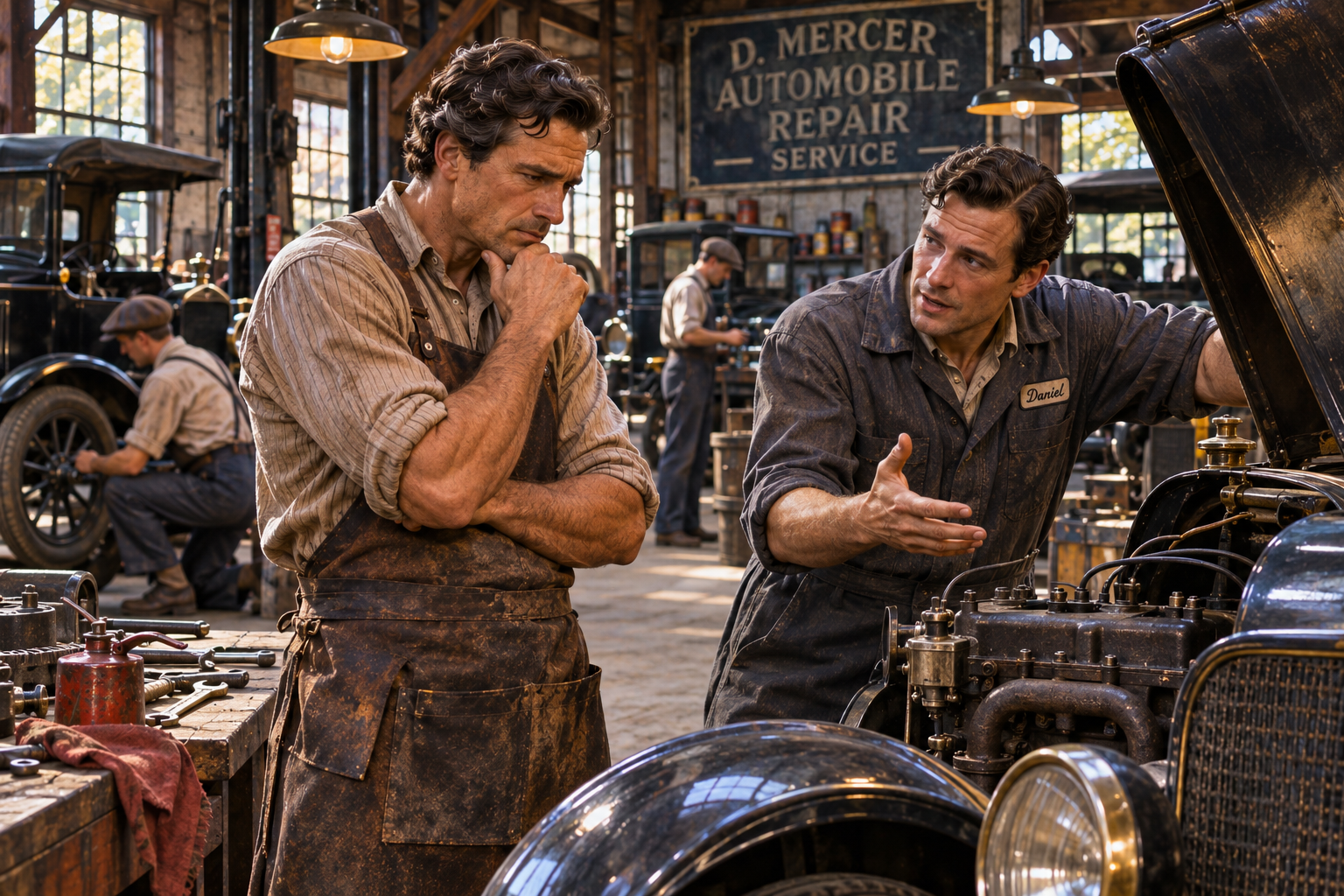
Daniel Mercer stopped by that October in clean gray coveralls with his name stitched over the pocket. His garage employed four mechanics now, and he had come with an offer: frame-straightening, custom bumper brackets, heavy ironwork the younger boys didn't know how to forge.
"Come work with me, Mr. Reed," Daniel said. "I can use you for ironwork whenever it comes in. Can't promise a full week's pay yet, but I'll teach you the engine side."
That evening, Samuel walked down to Daniel's garage after closing. The place smelled of gasoline, burnt oil, and vulcanized rubber instead of coal smoke and horsehair. Underneath a Buick parked over the inspection pit, a kid not much older than William was tightening bolts with a socket wrench, whistling through his teeth. Samuel watched him for five minutes, feeling every one of his forty-six years.
At home, Samuel and Clara sat at the dining table with the shop's worn cloth ledger between them. He couldn't expect to recover much from his tools and forge equipment now that fewer people wanted them. Daniel's offer meant uncertain hours while he learned the work. Turning his own shop into a garage would mean borrowing money for unfamiliar equipment and competing with businesses already established in town. At forty-six, with much of their savings tied up in the business and William just finding his feet as a clerk at the lumberyard, none of it looked like a safe bet.
"We're not in debt," Clara said, tracing the column of figures with one finger. "If we cut back and take whatever forge work and farm repairs come through the door, we can manage."
Samuel looked at his calloused hands—hands that knew every curve of a horse's hoof and nothing at all about carburetors. "All right," he said. "We hold on."
They held on through the crash of '29, when farmers patched harness with baling wire and brought in twenty-year-old plows to be hammered straight because nobody had cash for new steel. Samuel let his last helper go in 1931 and worked the forge alone, the high ceiling of his shop echoing every blow back at him.
In October of 1935, Clara doubled over beside the kitchen stove before breakfast, pale and slick with cold sweat.
Old Dr. Barnes came within the hour, examined her carefully, and frowned. "Might be her gallbladder, Sam. Whatever it is, I don't want her waiting here. She needs the surgeon at Mercy Hospital in Ashton."
William—thirty now, working as a bookkeeper at the lumberyard—pulled his secondhand Ford sedan up to the porch ten minutes later. Samuel helped Clara into the back seat, wrapped a wool blanket around her knees, and sat beside her as William eased the car onto the county highway.
Through the glass, red oak and stubble fields blurred past at thirty-five miles an hour. Samuel held Clara's cold hand and remembered the last time he had traveled to Ashton—in the spring of 1904, driving a team of grays through hub-deep spring ruts, stopping twice to rest and water the horses, taking most of the day to cover forty miles.
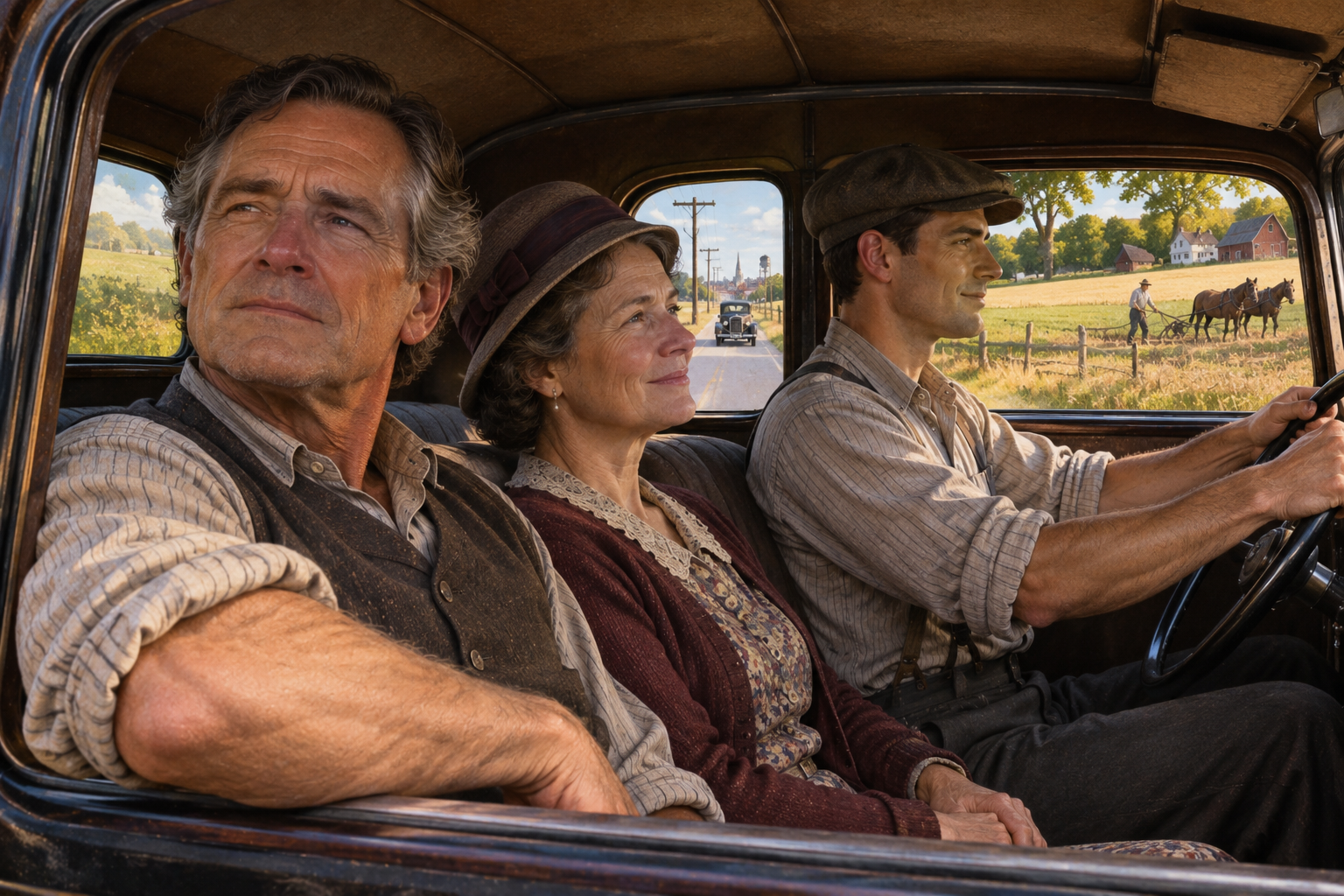
William pulled under the hospital portico in an hour and twenty minutes.
The surgeon operated that afternoon. Samuel and William waited until he came out to tell them that Clara's gallbladder had been badly inflamed. She had come through the operation, but she was weak and would need to remain in the hospital for several days.
The next evening, Samuel sat beside her bed, holding her hand while she slept. He remembered the long, rutted journey he had made to Ashton thirty-one years earlier. Without William's Ford, getting Clara here would have taken most of the day, and he did not like thinking about what that delay might have meant.
He thought, too, of the pledge he had signed at Collins's shop and the newspaper letter he had kept by his ledger. He had wanted his neighbors to keep horses for the sake of men like him. Yet when Clara needed help, he hadn't spent a moment wishing William owned a buggy instead. The thought stayed with him through the days Clara spent recovering. He was no less worried about his own business, but it had become harder to blame George, Walter Finch, or the others for choices he would make himself.
Clara recovered fully by winter, and Samuel kept his fire lit for four more years—shoeing the last few saddle horses in town, mending cultivator blades, sharpening axes before November frost.
By September of 1939, there were whole weeks when the anvil never rang once.
At fifty-nine, Samuel finally swept the cinders out of the cold forge and hung a handwritten Closed sign in the front window. Most of his tongs and hammers went to farmers for a dollar or two apiece. The big 150-pound Peter Wright anvil, its face dish-worn smooth from thirty-six years under his hammer, went to Daniel Mercer, who loaded it into the back of his pickup truck and pressed sixty dollars into Samuel's palm.
"Still the best piece of steel in the county," Daniel said, gripping Samuel's forearm. "Wouldn't have a business without what I learned over it."
Late that afternoon, Samuel stood in the middle of the stripped room, sunlight slanting through dusty panes onto bare floorboards. Footsteps sounded on the brick walk outside, and George Harris appeared in the doorway. Both men had gone gray at the temples, their shoulders stooped from decades behind a counter and an anvil.
George looked around the empty stalls and let out a long breath. "Never thought I'd see this door shut, Sam."
"Nor me."
George stepped inside, hands tucked into his coat pockets. For a moment neither man spoke. "You know," George said softly, "I still think about that first Republic truck. Felt like a traitor walking in here to tell you."
Samuel leaned back against the cool brick of the forge. "I was sore about it, George. More than I let on. I even put my name to that pledge Collins got into the paper." He glanced toward the street. "But when Clara needed that surgeon in Ashton four years back, I was mighty glad William had a Ford. I never once wished he'd brought a buggy."
George looked at him for a moment, then nodded. The old tension seemed to leave his face. They talked for another twenty minutes—about William's new baby, about how fast the creek had risen after last week's rain—before George checked his pocket watch and walked back out to his sedan.
Samuel followed him to the threshold and watched him pull into the steady afternoon traffic along Main Street.
Standing there in the doorway, Samuel listened. He could hear the low thrum of rubber tires on brick, the muted purr of idling engines outside the drugstore, the distant whine of a delivery truck shifting gears down by the depot. For forty-four years, the pulse of Millbrook had been iron striking stone—a sharp, living clatter that woke the town at daybreak and carried it home at dusk.
He realized he couldn't remember the last time he had heard a horse walk down Main Street.
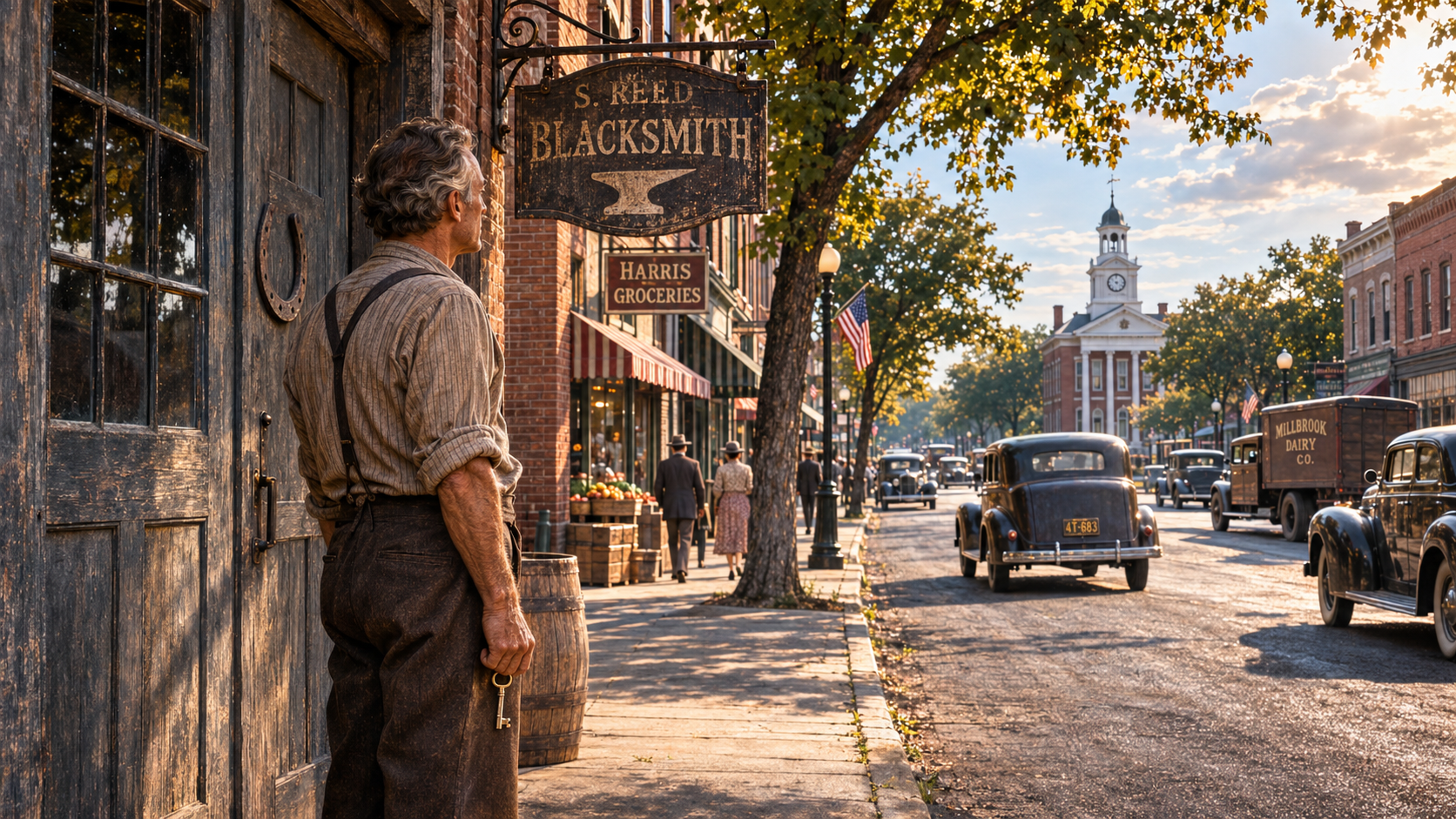
Samuel pulled the heavy timber doors shut, snapped the brass padlock through the hasp, and dropped the key into his coat pocket. He walked around the side of the shop. Across the yard, Clara was waiting on their porch in the late September sun, waving him home for supper.
Behind him, the steady hum of engines filled Main Street.
The world had not stopped moving. Only the sound had changed.
Author's Note
I created The Sound That Faded because I see striking parallels between the transition from horses to automobiles and the technological changes we are experiencing today, particularly with the rise of artificial intelligence.
I am increasingly concerned by the tendency to blame those who embrace new technology for the hardships experienced by people whose professions are being disrupted. There are calls for individuals and businesses to continue using traditional methods, even when new technologies offer significant advantages, simply to protect the livelihoods of those whose skills are being replaced. Those who choose to embrace these advances are sometimes criticized or made to feel guilty for doing so.
I do not minimize the very real consequences of technological change. People spend years developing specialized skills, building businesses, and establishing careers, only to discover that advances beyond their control have diminished the demand for their work. Their losses deserve genuine understanding and compassion.
But I do not believe the answer is to blame those who choose to take advantage of progress or expect them to forgo its benefits to preserve established professions. The people who purchased automobiles were not wrong to do so, even though their decisions contributed to the decline of blacksmiths and other traditional trades.
Samuel's story takes place more than a century ago, but the dilemma is remarkably familiar. We know how the automobile transformed society. We have yet to see the full consequences of artificial intelligence and other emerging technologies.
My hope is that this story encourages readers to recognize two truths that can coexist: We can have genuine compassion for those displaced by technological progress without condemning those who choose to embrace it.
Story concept and creative direction by Bob Taylor
Narrative developed, drafted, and revised with the assistance of ChatGPT. Illustrations created using AI under the creator's direction.